

The Celestial Ranks: Exploring Angelic Hierarchy in Theology
In the intricate tapestry of religious thought, the concept of an angelic hierarchy stands as a profound testament to humanity's enduring quest to understand the divine order. Far from being a mere collection of celestial beings, the structured ranks of angels in theology offer a sophisticated framework for comprehending God's relationship with creation, the transmission of divine will, and the very form of cosmic governance. This article delves into the historical and theological development of these celestial strata, drawing particularly from seminal works that have shaped our understanding of these spiritual intermediaries within the broader context of religion.
Introduction: The Divine Order and Celestial Beings
Across countless spiritual traditions, the heavens are imagined as populated by beings greater than humanity, yet subordinate to the divine. These angels, often serving as messengers, guardians, or executors of divine will, represent a crucial link between the transcendent and the immanent. However, the notion of a hierarchy among these celestial entities introduces a layer of profound philosophical and theological complexity, suggesting not a random assortment, but a meticulously organized cosmos reflecting God’s perfect order. This structured arrangement illuminates how divine power and grace descend through various levels, ultimately touching the earthly realm.
The Genesis of Angelic Ranks: Early Theological Contemplations
While references to different types of celestial beings appear in ancient texts, including the Old Testament's Seraphim and Cherubim, the systematic arrangement of these spiritual entities into a defined hierarchy primarily emerged within early Christian theology. Early Church Fathers pondered the nature and roles of these beings, attempting to reconcile scriptural allusions with philosophical concepts of order and emanation. It was through these contemplations that the groundwork for a more formalized structure began to take shape, seeking to articulate the form of divine administration within creation.
Dionysius the Areopagite and the Celestial Hierarchy
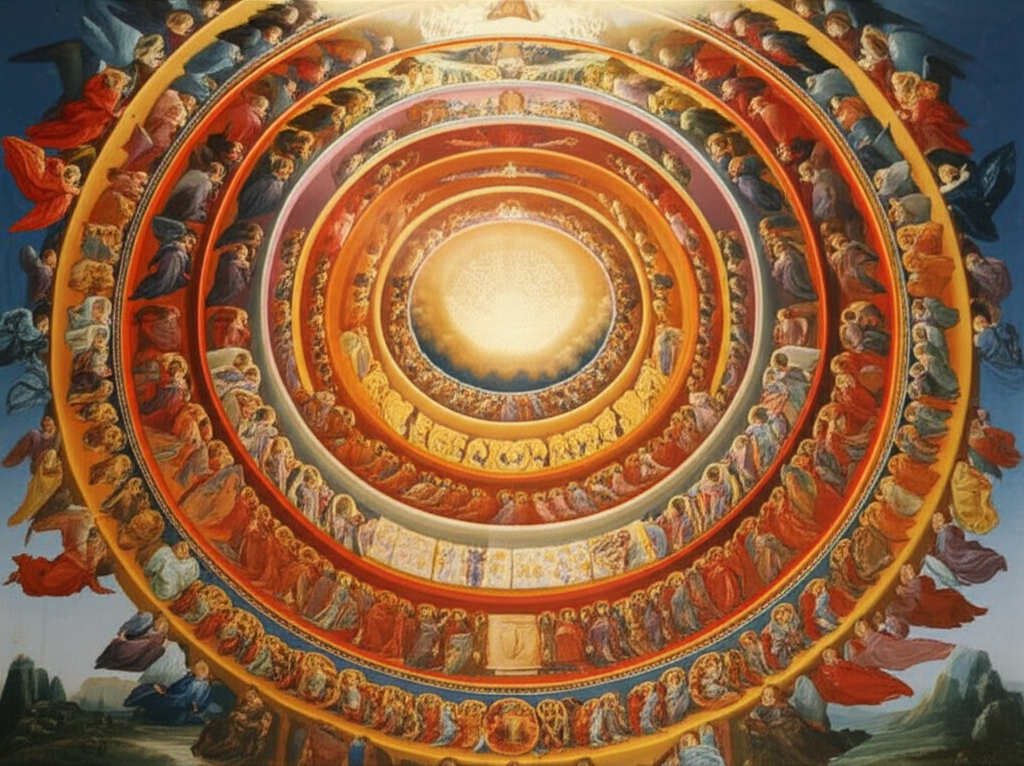
The most influential and enduring framework for understanding angelic hierarchy comes from the anonymous 5th or 6th-century Syrian Christian writer known as Dionysius the Areopagite. His treatise, The Celestial Hierarchy, became a cornerstone of Christian angelology, profoundly impacting both Eastern and Western theology for centuries. This work, often included in collections like the Great Books of the Western World for its philosophical and theological significance, meticulously organizes the celestial host into three hierarchies, each containing three choirs or orders. Dionysius posited that this hierarchy reflects the divine order itself, with each rank serving to purify, illuminate, and perfect the rank below it, thereby mediating divine enlightenment from God to creation.
The Three Hierarchies and Nine Choirs
Dionysius’s system delineates nine distinct choirs of angels, grouped into three hierarchies based on their proximity to God and their specific functions.
The First Hierarchy: Contemplation and Proximity
These choirs are closest to God, perpetually engaged in divine contemplation and radiating His glory. They are the most direct recipients of divine light and love.
- Seraphim: The "burning ones," characterized by their intense love for God and their fiery purity. They stand closest to the Divine Throne.
- Cherubim: Possessors of profound knowledge and wisdom, reflecting God's intelligence. They guard sacred spaces and reveal divine mysteries.
- Thrones: Represent divine justice and steadfastness. They are often depicted as wheels, symbolizing their role as the "seat" of God, carrying out His judgments with unwavering resolve.
The Second Hierarchy: Governance and Cosmic Order
These choirs are responsible for governing the cosmos, overseeing the natural world, and receiving divine commands from the first hierarchy.
- Dominions (or Lordships): Regulate the duties of the lower angels and ensure the divine plan is executed throughout the universe.
- Virtues (or Strongholds): Imbued with divine strength, they work miracles, provide courage, and dispense grace, often associated with cosmic phenomena.
- Powers (or Authorities): Ward off evil forces and maintain the cosmic order, preventing demonic interference and upholding the integrity of the universe.
The Third Hierarchy: Messengers and Guardians
These choirs are the most involved in human affairs, serving as direct intermediaries between God and humanity.
- Principalities (or Rulers): Guide nations, cities, and communities, inspiring human leaders and guarding large groups of people.
- Archangels: Chief messengers, often delivering messages of great importance (e.g., Gabriel, Michael). They lead the lower angels.
- Angels: The most numerous and familiar, these are the direct messengers, guardians, and protectors of individual humans, directly interacting with the earthly realm.
The Theological Significance of Angelic Form
The concept of an angelic hierarchy is not merely an exercise in celestial classification; it carries profound theological and philosophical weight. It underscores the belief in a universe structured by divine reason, where every being has its place and purpose. The form of this hierarchy reflects a divinely ordered cosmos, where grace and knowledge flow downwards, and prayer and praise ascend upwards. This structure emphasizes:
- Divine Providence: God's active governance extends to every level of creation through these intermediaries.
- Order and Harmony: The hierarchy illustrates a universe of perfect order, where each choir perfectly fulfills its assigned role.
- Mediation: Angels bridge the gap between the infinite God and finite creation, making the divine accessible and understandable.
This intricate structure, therefore, is a testament to the systematic nature of divine reality, where even spiritual beings are arranged in a form that mirrors the perfection and wisdom of their Creator.
Conclusion: A Ladder to the Divine
The exploration of angelic hierarchy in theology reveals a rich and complex dimension of religious thought. From the early scriptural allusions to the sophisticated systemization by Dionysius the Areopagite, the concept of celestial ranks offers a profound insight into how humanity has grappled with the nature of divine order and the intricate relationship between the Creator and creation. These angels, in their various forms and functions, serve not only as subjects of spiritual contemplation but also as a symbolic ladder, guiding our understanding from the earthly to the divine, reminding us of the structured beauty inherent in the cosmos.
YouTube Suggestions:
-
📹 Related Video: ARISTOTLE ON: The Nicomachean Ethics
Video by: The School of Life
💡 Want different videos? Search YouTube for: "Dionysius the Areopagite Celestial Hierarchy explained"
-
📹 Related Video: ARISTOTLE ON: The Nicomachean Ethics
Video by: The School of Life
💡 Want different videos? Search YouTube for: "Angelology Christian Theology"