

The Celestial Ladder: Unpacking Angelic Hierarchy in Theology
The concept of angelic hierarchy, a cornerstone of traditional theology and religion, posits a structured order among celestial beings. Far from mere mythological embellishment, this intricate system, notably articulated by Pseudo-Dionysius and refined by Aquinas, reveals profound insights into divine emanation, the nature of Form, and the very architecture of creation. This article delves into the historical development and philosophical implications of these ordered angelic choirs, examining their role in mediating between the divine and the material, and what their structured existence tells us about the cosmos.
The Genesis of Celestial Order: From Dionysius to Aquinas
The cosmos, as envisioned by many ancient philosophers and theologians, is rarely a chaotic expanse. Instead, it is often presented as a meticulously ordered reality, a grand symphony orchestrated by divine will. Within this intricate tapestry, the concept of angelic hierarchy stands as one of the most compelling and enduring illustrations of cosmic order. It’s not simply a fanciful notion of winged beings floating in the heavens; rather, it’s a sophisticated theological construct that has shaped Western thought for centuries, offering a profound lens through which to understand the divine, creation, and the very nature of Form.
The idea of a structured celestial realm finds its most influential articulation in the works attributed to Pseudo-Dionysius the Areopagite, particularly The Celestial Hierarchy. Writing around the 5th or 6th century, this anonymous author synthesized Neoplatonic philosophy with Christian theology, proposing a universe where all things emanate from God in a descending order of perfection. For Dionysius, angels were not just messengers; they were the very conduits of divine light and knowledge, arranged in a precise Form to facilitate this transmission.
Centuries later, Thomas Aquinas, drawing heavily from Dionysius and other patristic sources in his Summa Theologica (a work prominently featured in the Great Books of the Western World), meticulously cataloged and systematized this hierarchy. Aquinas, ever the rationalist, saw in the angelic orders a reflection of divine wisdom and an elegant solution to the problem of how an infinite God interacts with a finite creation. The angels, in their various ranks, embody different perfections and functions, mediating God's will and illumination to the lower orders of creation, including humanity.
The Nine Choirs: A Ladder to the Divine
The traditional angelic hierarchy is typically divided into three triads, or spheres, each with distinct functions and closer proximity to the divine source. This structured Form is not arbitrary but reflects a gradual unfolding of God's presence and power throughout creation.
Table: The Three Spheres and Nine Choirs of Angels
| Sphere | Choir | Primary Function/Nature |
|---|---|---|
| First Sphere | Seraphim | Closest to God, burning with love, purity, and zeal. |
| (Counselors) | Cherubim | Bearers of divine knowledge and wisdom, guardians of light. |
| Thrones | Embody divine justice and authority, stability of God's power. | |
| Second Sphere | Dominions | Regulate the duties of lower angels, convey God's commands. |
| (Governors) | Virtues | Perform miracles, give grace and courage, control natural forces. |
| Powers | Combat evil forces, protect against demonic influence. | |
| Third Sphere | Principalities | Guide nations and cities, protect religion and spiritual matters. |
| (Messengers) | Archangels | Chief messengers, often of great importance (e.g., Gabriel, Michael). |
| Angels | The most numerous, direct messengers to humanity, guardians. |
This intricate arrangement underscores a fundamental principle: the closer an angel is to God, the more perfectly it reflects the divine Form. Each rank possesses a distinct mode of understanding and operation, a specialized role in the cosmic drama.
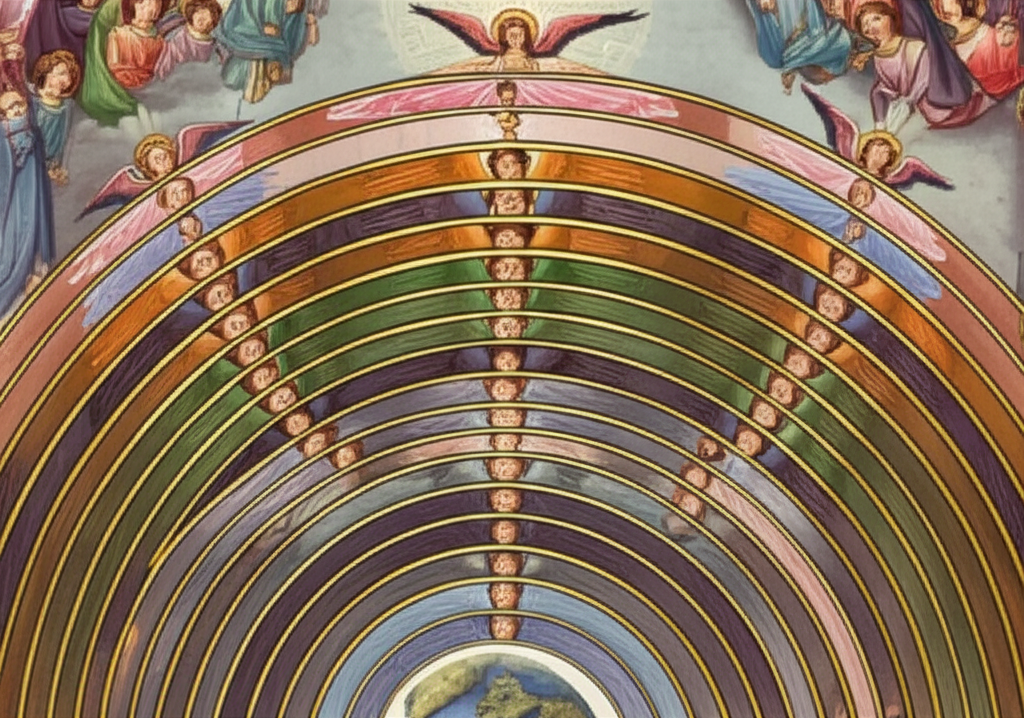
The Philosophical Weight of Hierarchy: Form, Mediation, and Understanding
Why such emphasis on hierarchy? For philosophers and theologians of the medieval period, hierarchy was not merely an organizational chart; it was a reflection of reality itself. Plato's concept of Forms, where perfect, immutable essences exist independently of the material world, found a theological echo in the angelic orders. Angels, particularly those in the higher spheres, could be seen as embodying more perfect Forms of intelligence and will, closer to the ultimate Form of the Good (God).
Moreover, the hierarchy addresses the problem of divine transcendence and immanence. How does an utterly transcendent God interact with the material world without diminishing His perfection? Through mediation. The angelic choirs act as a graded series of intermediaries, each passing divine illumination and will down the chain, much like a series of lenses focusing light. This ensures that God's power and knowledge are communicated effectively and appropriately to every level of creation.
The study of angelic hierarchy, therefore, is not just about understanding celestial beings; it's about understanding the very structure of being, the nature of causality, and the pathways of divine grace. It forces us to contemplate the different modes of intelligence and the diverse ways in which creation participates in the divine.
Contemporary Echoes and Enduring Questions
While modern theology and religion might not emphasize the literal cataloging of angelic choirs with the same rigor as Aquinas, the underlying philosophical questions remain profoundly relevant. The concept of hierarchy, of ordered Form and function, still permeates our understanding of systems, whether natural, social, or spiritual.
- How do different levels of being relate to a primary source?
- What does it mean for something to be "higher" or "lower" in terms of perfection or proximity to ultimate truth?
- Does the universe operate according to an inherent, structured order, or is it fundamentally chaotic?
The angelic hierarchy, though rooted in specific historical and theological contexts, serves as a powerful metaphor for these enduring inquiries. It prompts us to consider the unseen forces and structures that might govern existence, urging a deeper reflection on the intricate design that many believe underpins the cosmos.
📹 Related Video: ARISTOTLE ON: The Nicomachean Ethics
Video by: The School of Life
💡 Want different videos? Search YouTube for: "Angelic Hierarchy Explained Aquinas Pseudo-Dionysius"
📹 Related Video: What is Philosophy?
Video by: The School of Life
💡 Want different videos? Search YouTube for: "Philosophy of Angels Medieval Theology Structure of Being"
Conclusion:
The angelic hierarchy in theology is far more than a quaint detail of ancient religion. It is a sophisticated philosophical and theological system, meticulously crafted to explain divine order, the transmission of grace, and the very nature of existence. From the burning love of the Seraphim to the guiding hand of the guardian angel, each rank embodies a specific Form of divine perfection and function, mediating between the infinite and the finite. By delving into these celestial orders, we are not just exploring the heavens; we are exploring profound questions about the structure of reality, the nature of intelligence, and our own place within a seemingly boundless and beautifully ordered cosmos. The Great Books of the Western World continue to offer us these profound insights, inviting us to ponder the celestial ladders that ascend to the divine.