

And Don't Just Close Your Eyes...
Defining the Euclidean Point
(The scene is a tranquil, minimalist space under a sky of soft, unchanging light. Sophia sits on a simple stone bench. André and Carl approach and take their places beside her.)
Sophia: Welcome, friends. I have been pondering a foundational idea, a seed from which vast forests of thought have grown. I ask you: what is a Euclidean point?
André: (Gazing into the middle distance as if at a horizon) To truly grasp it, one must first be willing to become lost. We are accustomed to the shoreline of our senses—the mark of a pen, a grain of sand, a distant star. We call these things points. But they are merely anchors. To understand the idea of a point, one must gather the courage to pull up that anchor, to sail away from the comfort of the visible and tangible world, and venture into an ocean of pure abstraction.
Carl: An excellent metaphor, André. And the nature of that abstract ocean is very specific. The truths we find there are absolute, but they are not truths about the world you’ve left behind. The definition of a point within a geometric system has the same flawless certainty as the proposition that all bachelors are unmarried. It is true by its very construction. But this perfection comes at a price: it carries no information about any empirical matter. The geometric point tells us nothing about the grain of sand or the star. It is factually empty.
Sophia: So, you suggest a paradox. André, you say we must abandon the physical to find the point. And Carl, you argue that once found, this point offers a certainty that is completely detached from the physical. It seems geometry, in its purest form, is not about the world at all.
Man cannot discover new oceans unless he has the courage to lose sight of the shore.
— André Gide (1869-1951)
Carl: It is not. It is a self-contained logical game of breathtaking elegance. The point is a primitive concept, a token whose meaning is derived only from the rules of the game—the axioms. It has position but no size, an existence defined purely by its relationship to other points and lines.
Sophia: I have heard it suggested that we should treat pure geometry with a kind of disclaimer, much like one used for a work of fiction. A warning to the student that the system does not intend to portray the spatial properties of actual bodies, and any similarity between its ideal concepts and their real-world connotations is entirely by chance.
André: (Nodding enthusiastically) Yes! That is the very release I speak of! Such a disclaimer is not a limitation but a declaration of freedom. It unshackles the mind from trying to perfectly map the ideal onto the flawed. It allows the journey to begin. Without that understanding, we remain stranded on the coast, forever mistaking the footprint for the person.
Sophia: This conceptual threshold, this boundary where the physical analogy must be abandoned for the purely logical to emerge, is the crucial step. Let us call it the planksip point—a horizon in our understanding. To define the Euclidean point is to cross it.
Carl: Exactly. Before that horizon, we see a dot. After we cross it, we understand a logical necessity. Its truth is not derived from observation but from definition. It conveys no empirical knowledge because its purpose is to be a cornerstone for a system of analytic truths, not a description of the universe.
Sophia: Then we are in agreement. The definition of a Euclidean point is not a description but an intellectual act. It requires the explorer’s courage to lose sight of the familiar shore of the senses, and it delivers the logician’s reward: a concept of perfect certainty, made so precisely because it makes no claim on the messy, beautiful, and empirical world it leaves behind. It is a pure beginning.
The planksip point in the p.(x) QFT Horizon Principle
...to characterize the import of pure geometry, we might use the standard form of a movie disclaimer: No portrayal of the characteristics of geometrical figures or of the spatial properties of relationships of actual bodies is intended, and any similarities between the primitive concepts and their customary geometrical connotations are purely coincidental.
The propositions of mathematics have; therefore, the same unquestionable certainty which is typical of such propositions as "All bachelors are unmarried," but they also share the complete lack of empirical content which is associated with that certainty: The propositions of mathematics are devoid of all factual content; they convey no information whatever on any empirical subject matter...
— Carl Gustav Hempel (1905-1997)
The planksip Writers' Cooperative is proud to sponsor an exciting article rewriting competition where you can win part of over $750,000 in available prize money.
Figures of Speech Collection Personified
Our editorial instructions for your contest submission are simple: incorporate the quotes and imagery from the above article into your submission.
What emerges is entirely up to you!
Winners receive $500 per winning entry multiplied by the article's featured quotes. Our largest prize is $8,000 for rewriting the following article;
 Heraclitus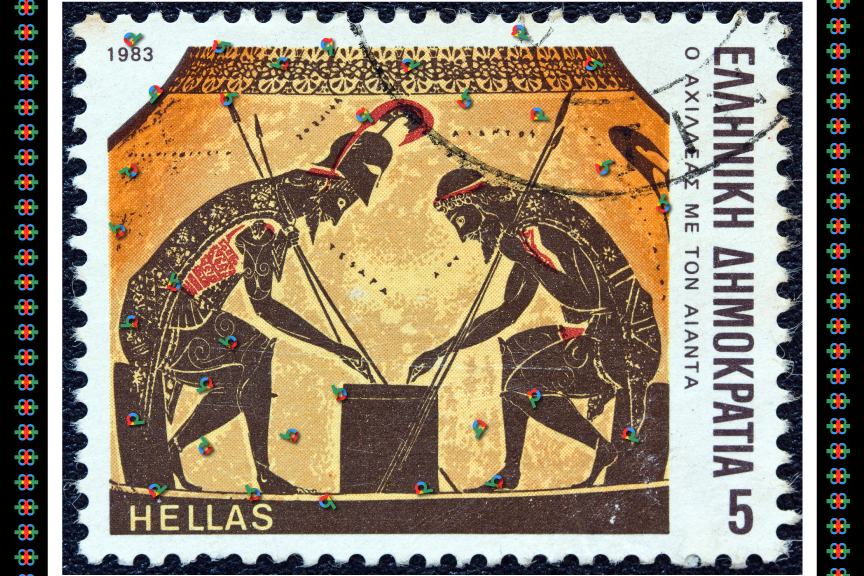
At planksip, we believe in changing the way people engage—at least, that's the Idea (ἰδέα). By becoming a member of our thought-provoking community, you'll have the chance to win incredible prizes and access our extensive network of media outlets, which will amplify your voice as a thought leader. Your membership truly matters!