

In an age saturated with information, the ability to critically discern truth from manipulation is more vital than ever. This article delves into how understanding rhetoric, the art of persuasion, provides an indispensable lens through which to analyze and deconstruct propaganda. By examining the deliberate use of language to shape opinion, particularly in the context of government and public discourse, we can better equip ourselves to navigate complex narratives and make informed judgments.
Unveiling the Mechanisms of Persuasion: A Philosophical Imperative
Propaganda, at its core, is a calculated effort to influence opinion or action through the strategic dissemination of information, often biased or misleading. Yet, it rarely operates through overt coercion; instead, it subtly persuades, leveraging the very tools of communication that define human interaction. To truly understand its insidious power, we must turn to the venerable discipline of rhetoric, a subject explored in depth by the foundational texts of the Great Books of the Western World.
Aristotle, in his seminal work Rhetoric, meticulously cataloged the means by which persuasion is achieved: through logos (appeal to logic), pathos (appeal to emotion), and ethos (appeal to credibility). These are not inherently sinister; they are the fundamental building blocks of effective communication. However, in the hands of those seeking to manipulate, they become potent instruments of propaganda, twisting truth and manufacturing consent.
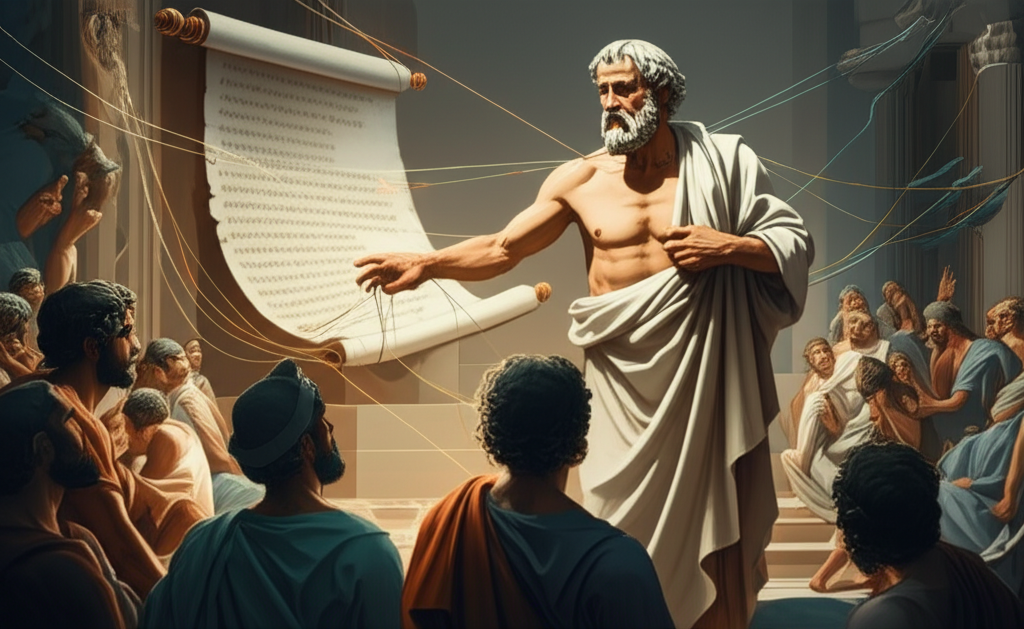
The Art of Rhetoric: A Double-Edged Sword
Rhetoric is the study of how discourse influences an audience. It is a neutral tool, capable of being used for noble aims—to educate, to inspire, to advocate for justice—or for ignoble ones, such as deception and control. The classical understanding, particularly from the likes of Plato in his dialogues, often grappled with this duality, questioning whether rhetoric could ever truly serve truth if its primary aim was persuasion, regardless of veracity.
Propaganda exploits this duality by employing sophisticated rhetorical techniques not to enlighten, but to engineer opinion. It doesn't necessarily lie outright, but rather selectively presents facts, distorts context, or amplifies certain emotional appeals to guide the audience towards a predetermined conclusion. The careful choice of language is paramount here, as words are imbued with power to frame reality.
Propaganda's Nexus with Government and Language
The relationship between government and propaganda is historically intimate. From ancient empires to modern states, those in power have recognized the efficacy of shaping public opinion to maintain control, garner support for policies, or demonize adversaries. This is achieved primarily through the strategic deployment of language.
Consider how different terms can frame the same event: is it a "military intervention" or an "invasion"? Is it a "tax reform" or a "tax hike"? The precise language used, often crafted by skilled rhetoricians, can drastically alter public perception and acceptance. Governments, through official channels, media outlets, and even social media, meticulously curate narratives designed to elicit specific responses from the populace.
Dissecting Propaganda: A Rhetorical Toolkit
To effectively analyze propaganda, we must first learn to identify the rhetorical strategies it employs. Here are some common techniques, often found in the historical and political discourse studied in the Great Books:
- Ad Hominem (Attack the Person): Instead of refuting an argument, the propagandist attacks the character, motive, or other attribute of the person making the argument.
- Example: "You can't trust her economic plan; she's never run a business herself."
- Straw Man (Misrepresent the Argument): Distorting or exaggerating an opponent's argument to make it easier to attack.
- Example: "My opponent wants to cut all social programs, leaving the poor to starve." (When the opponent actually proposed targeted reforms.)
- Appeal to Emotion (Pathos): Manipulating an audience's emotions (fear, pity, anger, patriotism) to win an argument, often bypassing logical reasoning.
- Example: "If we don't pass this law, our children's future is doomed!"
- False Dilemma (Black or White): Presenting only two options as if they are the only possibilities, when in fact more options exist.
- Example: "Either you support the new policy, or you're against progress."
- Bandwagon (Appeal to Popularity): Suggesting that an idea is correct or desirable because many people believe it.
- Example: "Everyone knows this is the right thing to do."
- Glittering Generalities: Using emotionally appealing words or phrases that are associated with highly valued concepts but carry no specific meaning.
- Example: "For freedom, justice, and prosperity, vote for us!"
- Plain Folks: Attempting to convince the public that the speaker's views reflect those of the common person.
- Example: "As a regular working person, I understand your struggles."
Cultivating Critical Discernment
The antidote to propaganda is not simply skepticism, but informed skepticism, grounded in a robust understanding of rhetoric. By recognizing the persuasive techniques at play, we can move beyond simply reacting to the content and begin to analyze the underlying intent and methodology. This critical faculty allows us to question:
- Who is speaking, and what is their ethos? Is their credibility genuine or manufactured?
- What logical arguments (logos) are being presented? Are they sound, or are there fallacies?
- What emotions (pathos) are being evoked, and why? Are they being used to cloud judgment?
- What language choices are being made, and how do they frame the issue?
- What is the likely agenda of the source, particularly if it's a government or politically motivated entity?
By engaging with information in this analytical manner, we honor the philosophical tradition that seeks truth and clarity. It empowers us to resist the subtle pressures to conform our opinion to external agendas and instead forge our own understanding, based on rigorous examination and independent thought.
YouTube: "Aristotle's Rhetoric Explained"
YouTube: "Understanding Propaganda Techniques Philosophy"
📹 Related Video: What is Philosophy?
Video by: The School of Life
💡 Want different videos? Search YouTube for: "Analyzing Propaganda through Rhetoric philosophy"