

Analyzing Political Systems Through the Lens of Logic
The intricate tapestry of human governance, from ancient city-states to modern democracies, often appears to be a chaotic dance of power, ambition, and shifting ideologies. Yet, beneath this surface, a profound, enduring tool offers clarity and insight: logic. This article argues that logic and reasoning are not merely academic exercises but indispensable instruments for understanding, evaluating, and even designing the government and the state. By applying rigorous logical frameworks, we can dissect political arguments, uncover hidden assumptions, assess the consistency of policies, and ultimately strive for more coherent and just forms of governance, a practice deeply rooted in the philosophical traditions found within the Great Books of the Western World.
The Unseen Architecture: Logic as the Blueprint of the State
At its core, political philosophy is an exercise in reasoning. Long before the advent of modern political science, thinkers grappled with fundamental questions: What constitutes a just state? What is the best form of government? How should power be distributed? Their answers, however varied, were almost invariably constructed through a process of logical deduction and induction, building arguments step-by-step.
The Dawn of Logical Governance: Plato and Aristotle
Consider the foundational works of Plato and Aristotle. In Plato's Republic, we witness a grand, deductive argument for an ideal state ruled by philosopher-kings. Plato doesn't merely assert this vision; he builds it through a series of logical inferences, starting from the nature of justice in an individual and scaling it up to the polity. His classification of governments (timocracy, oligarchy, democracy, tyranny) is not arbitrary but a logical progression of decline based on the corruption of ruling principles.
Aristotle, in his Politics, takes a more inductive approach. He meticulously observes and categorizes existing governments of his time, using these empirical data points to derive principles about their stability, efficiency, and justice. His distinction between "correct" and "deviant" forms of rule (e.g., kingship vs. tyranny, aristocracy vs. oligarchy, polity vs. democracy) is predicated on the logical consistency of their aims – whether they serve the common good or merely the rulers' interests. Both philosophers, despite their differing methods, underscore the indispensable role of logic in constructing and critiquing political theory.
Deconstructing Political Arguments: The Power of Reasoning
In contemporary discourse, political debates often devolve into emotional appeals or rhetorical flourishes. Here, logic serves as our shield and sword. It allows us to cut through the noise and evaluate the underlying structure of an argument.
Identifying Fallacies and Inconsistencies
A key aspect of applying logic to political systems is the ability to identify fallacies – errors in reasoning that undermine the validity of an argument. Common political fallacies include:
- Ad Hominem: Attacking the person rather than the argument.
- Straw Man: Misrepresenting an opponent's argument to make it easier to attack.
- Slippery Slope: Asserting that a relatively small first step inevitably leads to a chain of related, usually negative, consequences.
- False Dichotomy: Presenting only two options as if they are the only possibilities, when more exist.
- Appeal to Emotion: Manipulating an emotional response in place of a valid or compelling argument.
By recognizing these, we can discern whether a policy proposal or a political platform holds genuine merit or is simply designed to persuade through manipulation. A sound political argument, like a sound philosophical argument, requires valid premises leading to a logical conclusion.
The Social Contract: A Logical Construct
The social contract theorists of the Enlightenment – Hobbes, Locke, and Rousseau – provide compelling examples of using logic to construct a theory of the state and government. Each began with a hypothetical "state of nature" and, through a series of logical deductions about human nature and rational self-interest, arrived at different conclusions regarding the ideal form of social organization.
- Hobbes's Leviathan: Logically deduces that rational individuals, fearing the "war of all against all" in the state of nature, would surrender their rights to an absolute sovereign for security.
- Locke's Second Treatise of Government: Argues that individuals possess natural rights (life, liberty, property) even in the state of nature, and thus logically consent to a limited government whose primary role is to protect these rights.
- Rousseau's The Social Contract: Postulates that legitimate political authority arises from a social contract where individuals collectively form a "general will," leading to a form of participatory democracy.
Each of these influential theories is a testament to the power of reasoning in constructing a coherent philosophical basis for the state.
Evaluating Governance: A Logical Framework
Beyond understanding how political systems are theorized, logic offers a crucial framework for evaluating their practical effectiveness and ethical implications.
Internal Consistency and Policy Coherence
A well-functioning government should ideally operate with a degree of internal consistency. Do its stated principles align with its actual policies? Does legislation contradict other existing laws or constitutional tenets? Logic helps us highlight these discrepancies. For instance, a government that champions individual liberty but implements highly restrictive surveillance measures presents a logical inconsistency that demands examination.
Consider the following criteria for logical evaluation:
| Logical Criterion | Application to Political Systems | Example |
|---|---|---|
| Consistency | Do the system's principles, laws, and policies cohere without contradiction? | A state claiming equality while upholding discriminatory laws. |
| Coherence | Are the various parts of the government's structure and functions logically integrated? | Disjointed policies that undermine each other's objectives. |
| Validity | Do policy conclusions logically follow from stated premises and evidence? | A policy based on flawed data or unsupported assumptions. |
| Soundness | Are the premises themselves true, and do they lead to valid conclusions? | A government program built on an inaccurate understanding of human behavior. |
| Non-Contradiction | Can the state simultaneously uphold two opposing principles without undermining itself? | Advocating for both unlimited free speech and strict censorship. |
Predicting Outcomes Through Logical Inference
When a government proposes a new policy, it often does so with predicted outcomes in mind. Logic allows us to critically assess whether these outcomes are genuinely likely to follow from the proposed actions. This involves:
- Identifying Premises: What assumptions is the policy built upon (e.g., human behavior, economic responses)?
- Tracing Inferences: Does the policy logically connect these premises to the desired outcomes?
- Considering Counterarguments: Are there alternative logical paths or unforeseen consequences that the policy's proponents have overlooked?
This form of reasoning is essential for effective governance, moving beyond wishful thinking to a more grounded understanding of cause and effect in the complex social and economic spheres.
The Enduring Quest for a Rational State
While logic provides an invaluable framework, we must acknowledge that political systems are not purely rational constructs. Human emotions, power dynamics, historical contingencies, and sheer irrationality often play significant roles. Yet, this does not diminish the importance of reasoning. In fact, it amplifies it.
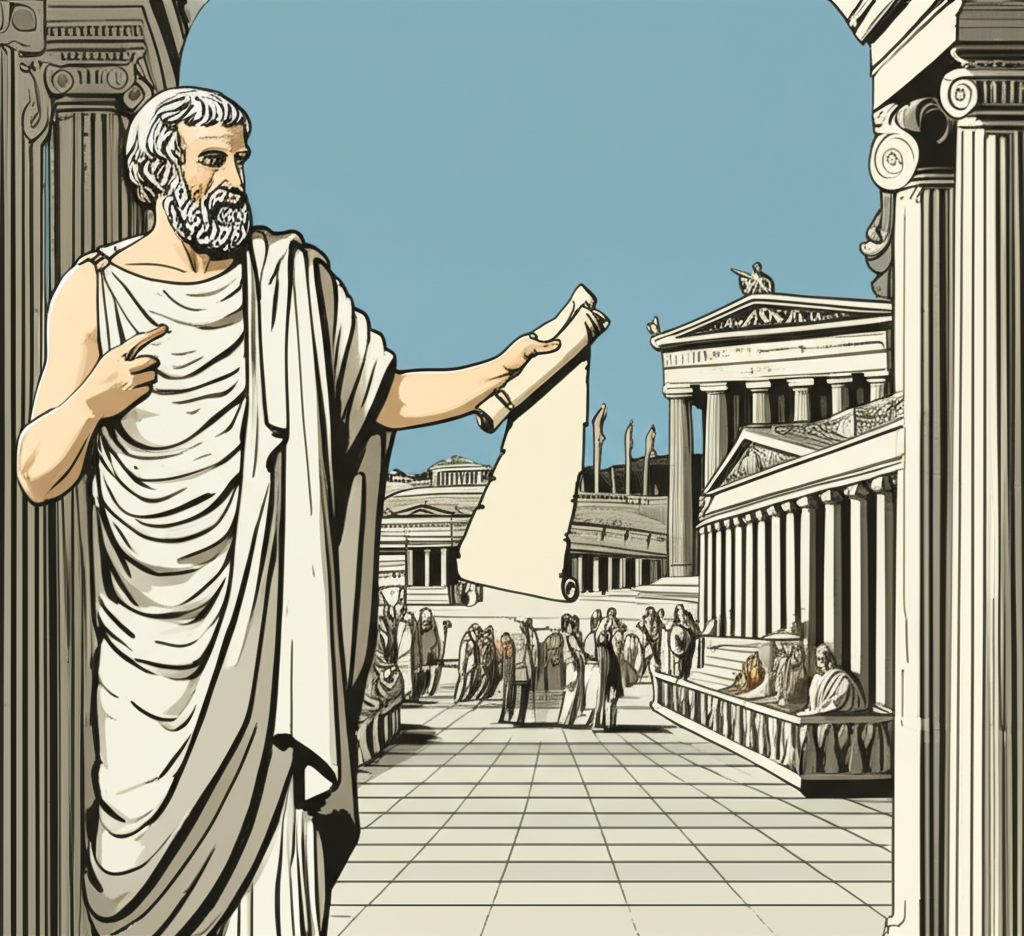 , with lines of logical inference or thought connecting his observations to his analyses.)
The continuous application of logic in political analysis serves as a vital bulwark against demagoguery, arbitrary rule, and incoherent policy. It encourages critical thinking, informed debate, and the pursuit of a state that is not just powerful, but also just, consistent, and accountable. Our engagement with the foundational texts in the Great Books reminds us that the pursuit of a better government is, at its heart, a sustained act of reasoning.
YouTube: Political Philosophy Explained: Social Contract Theory
YouTube: Critical Thinking in Politics: Identifying Logical Fallacies
📹 Related Video: What is Philosophy?
Video by: The School of Life
💡 Want different videos? Search YouTube for: "Analyzing Political Systems through Logic philosophy"